
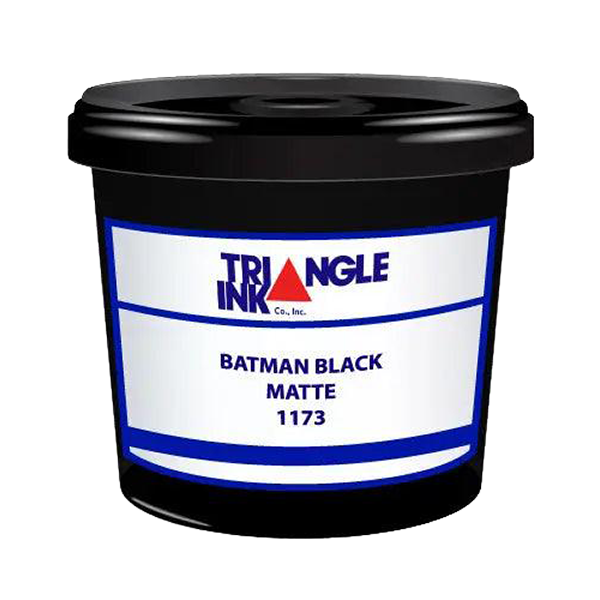
Triangle Ink 1173 Batman Black Matte - 1 Gallon
TR-1173-G
$76.00$0.00
New to SPSI? Open an account
Will-call pickup
-
Maple Grove, MN Corporate Headquarters8 in stock
Usually ready in 24 hours
Ships same day from MN & TX · Free shipping on supply orders $300+
Deep, rich matte black plastisol screen printing ink formulated for smooth wet-on-wet printing, consistent coverage, and dependable production on cotton and cotton/polyester garments.
Characteristics
Triangle Ink 1173 Batman Black Matte is a ready-to-use, multipurpose plastisol ink from Triangle Ink's Tri-Flex 1100 Series. Designed for professional textile screen printing, Batman Black produces a deep black appearance with a matte finish and is formulated for reliable direct wet-on-wet production.
Recommended for 100% cotton and cotton/polyester blends, this versatile ink can be used on knit and woven T-shirts, sweatshirts, jerseys, fleece goods, athletic apparel, and similar textile applications. It can also be used for producing cold-peel plastisol transfers and limited hot-peel transfer applications when paired with appropriate transfer paper.
Batman Black can be printed through a broad range of mesh counts, allowing printers to adjust ink deposit and image detail for different production requirements. Triangle Ink's technical information lists 60–280 threads/in. monofilament mesh, with 110T identified as a popular choice.
Its ready-to-use formulation and smooth printing characteristics make Triangle Ink 1173 Batman Black Matte a practical choice for professional screen printers producing matte black graphics, athletic apparel, promotional garments, and general textile designs.
- Deep Batman Black color with a matte finish
- Part of the Triangle Ink Tri-Flex 1100 Series
- Ready-to-use plastisol formulation
- Designed for direct wet-on-wet printing
- Smooth, dependable production performance
- Suitable for manual and production screen printing
- Wide usable mesh range of 60–280 threads/in.
- 110T monofilament mesh is a popular choice
- Recommended for 100% cotton and cotton/polyester blends
- Can be used for direct garment printing and plastisol transfers
- Suitable for athletic, leisure, promotional, and general apparel
- Available in quart and gallon packaging according to Triangle Ink specifications
- 100% cotton garments
- Cotton/polyester blends
- T-shirts and sweatshirts
- Hoodies
- Jerseys
- Fleece garments
- Athletic apparel
- Leisurewear
- Promotional apparel
- Compatible knit and woven textiles
- Mix Before Printing: Stir the ink thoroughly before production to ensure smooth, consistent printing characteristics.
- Ready-to-Use Formulation: Triangle Ink specifies that the Tri-Flex 1100 Series is intended to be used directly from the container. Unnecessary reducers or additives can affect opacity, curing, and other ink properties.
- Mesh Selection: Adjust mesh count according to the desired ink deposit and artwork detail. A 110T monofilament mesh is a common choice, while the broader 60–280 threads/in. range provides flexibility for different applications.
- Squeegee Selection: A sharp-edge squeegee with a recommended hardness of 60–70 durometer is suitable for typical applications.
- Stencil Preparation: Select an appropriate direct or indirect emulsion or capillary film based on the artwork, mesh count, and desired ink deposit.
- Wet-on-Wet Printing: Optimize screen tension, off-contact, squeegee pressure, and print settings to maintain consistent coverage during production.
- Transfer Printing: Use appropriate transfer paper and application procedures when producing cold-peel or limited hot-peel plastisol transfers.
- Proper Curing: Verify that the entire ink film reaches the required cure range of approximately 315°F–330°F. Actual curing requirements depend on ink deposit, garment construction, and dryer efficiency.
- Production Testing: Perform wash and adhesion testing before and during production runs to verify complete curing and dependable print durability.
- Storage: Keep containers tightly sealed and store at approximately 65°F–90°F (18°C–32°C), away from direct sunlight and excessive heat.
- Cure Temperature: Triangle Ink specifies an approximate cure range of 315°F–330°F for the Tri-Flex 1100 Series.
- Complete Cure: Ensure the entire ink film reaches the required curing conditions. Dryer temperature settings alone do not confirm that the ink has fully cured.
- Ink Deposit: Heavy ink deposits may require additional curing energy or dwell time.
- Fabric Considerations: Garment construction, fabric moisture, and dryer efficiency can affect curing performance.
- Additives: Avoid unnecessary reducers or additives because they can affect opacity, curing, and other performance characteristics.
- Wash Testing: Conduct wash and adhesion testing before full production and whenever printing conditions change.
- Deep matte black graphics
- General spot-color printing
- Direct wet-on-wet textile printing
- 100% cotton T-shirts
- Cotton/polyester blended garments
- Sweatshirts and hoodies
- Jerseys and fleece garments
- Athletic apparel
- Leisurewear
- Promotional apparel
- Cold-peel plastisol transfers
- Limited hot-peel transfer applications
- Professional production screen printing
